Trust Marks and Empty Promises: The Widening Gulf Between Verification and Actual Security
Somewhere in the evolution of the commercial internet, a small padlock icon became a proxy for safety. A blue checkmark came to mean authenticity. A "Verified" seal on a website's checkout page became the signal that a transaction was secure. These symbols were introduced with genuine purpose. What they have become, in many contexts, is something considerably more complicated — and more dangerous.
The gap between what a verification symbol promises and what it actually certifies has widened substantially as these marks have been commodified, replicated, and in some cases deliberately weaponized. For users who have learned to rely on visual trust cues, that gap is not merely an inconvenience. It is a vulnerability.
What Verification Actually Certifies — and What It Does Not
Consider the HTTPS padlock, still one of the most widely recognized security indicators on the internet. For years, security awareness campaigns told users to look for the padlock before entering sensitive information. The underlying message was: padlock equals safe.
The padlock indicates that the connection between your browser and the server is encrypted — that data transmitted between the two cannot be easily intercepted in transit. It certifies nothing whatsoever about the identity, legitimacy, or intentions of whoever operates the server on the other end.
Phishing sites have carried valid HTTPS certificates for years. Obtaining a Domain Validation (DV) certificate — the kind that triggers the padlock — requires demonstrating control over a domain, not demonstrating that you are who you claim to be. A threat actor who registers "secure-bankofamerica-login.com" and obtains a free DV certificate from a public certificate authority will display a padlock in every visitor's browser. The padlock is technically accurate and practically misleading.
Research from the Anti-Phishing Working Group has consistently found that the majority of phishing sites now use HTTPS. The padlock, once a meaningful filter, has been rendered nearly useless as a trust signal by the mass availability of free certificates.
The Blue Checkmark Economy
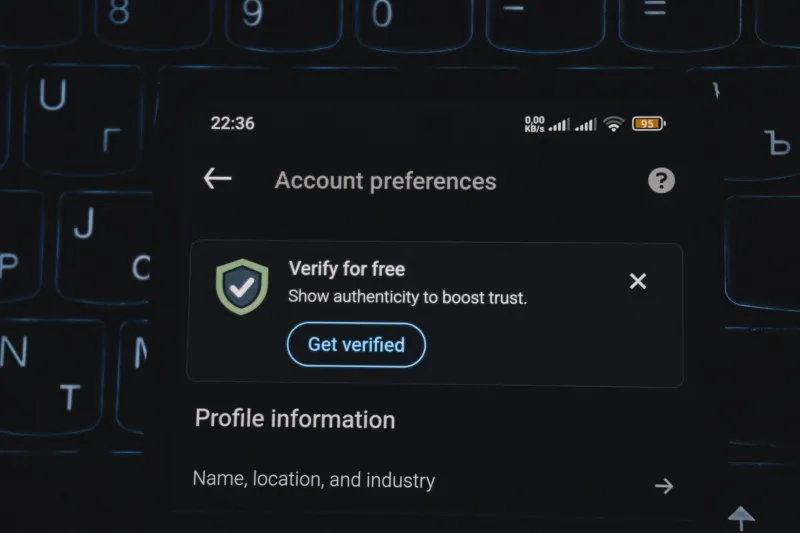
Social media verification was conceived as a solution to impersonation — a way for platforms to signal that an account genuinely represented the public figure, brand, or organization it claimed to be. In practice, the blue checkmark became something more culturally powerful: a mark of credibility, authority, and legitimacy that users extended well beyond its technical definition.
When major platforms began offering paid verification tiers — most visibly Twitter's transformation into X in late 2022 — the already-strained relationship between the checkmark and genuine identity authentication effectively collapsed. Anyone willing to pay a monthly subscription fee could obtain the same visual indicator that had previously been reserved for accounts that passed identity review.
The consequences were immediate and well-documented. Impersonation accounts for pharmaceutical companies, financial institutions, and government agencies appeared bearing checkmarks, posting misinformation and, in several cases, directing followers to fraudulent websites. The checkmark, rather than filtering for legitimacy, had become a prop available to any actor willing to spend eight dollars.
Other platforms have faced analogous problems through different mechanisms. Verified accounts on various platforms have been compromised and used to distribute scam links, effectively lending the credibility of a legitimate verified identity to malicious content. The verification status persists even as the account's behavior changes.
Third-Party Trust Seals: Security Theater in the Checkout Lane
E-commerce introduced its own category of trust signaling: the third-party security seal. Logos from organizations with names suggesting rigorous oversight — displayed prominently on checkout pages — became standard fixtures of online retail, particularly in the mid-2000s and early 2010s.
The certification processes behind these seals vary enormously, and in many cases are far less rigorous than their visual presentation implies. Some seals are issued following automated scans of a website's technical configuration; others require periodic manual review; a number have been obtained through processes that security researchers have described as superficial.
More significantly, the seals themselves are static images. A fraudulent site can copy the HTML or image file of a trust seal from a legitimate site and display it without any certification at all. Several consumer protection investigations have documented fraudulent e-commerce operations displaying seals from organizations that had no record of ever certifying them. Without clicking through to verify the certification independently — a step virtually no consumer takes — the visual cue is indistinguishable from the genuine article.
Domain Spoofing and the Limits of Name Recognition
Beyond certificates and seals, threat actors have developed sophisticated approaches to exploiting the visual vocabulary of brand trust through domain spoofing — registering domains that closely mimic those of legitimate organizations.
Homograph attacks represent a particularly refined variant. Unicode characters that are visually identical or nearly identical to standard Latin characters can be substituted in domain names, producing addresses that appear to spell a trusted brand name but resolve to an entirely different server. The domain "аррӏе.com" — with Cyrillic characters substituted for several letters — is visually indistinguishable from "apple.com" in most fonts, yet it is a completely separate domain that could be registered and pointed anywhere.
Browsers have implemented mitigations for homograph attacks, but the broader category of confusable domains — those that rely on character substitution, hyphenation, subdomains, or added words — remains a substantial vector. The Federal Trade Commission receives thousands of reports annually related to fraudulent websites impersonating legitimate businesses, many of which involve domain names engineered to create false recognition.
Rebuilding a More Critical Posture
The appropriate response to this landscape is not to abandon all trust signals but to develop a more accurate mental model of what each signal actually certifies.
HTTPS confirms encryption, not identity. The padlock should be treated as a minimum technical requirement, not a safety guarantee. Verify the full domain name carefully, particularly on sites where you intend to enter credentials or payment information.
Verification badges certify platform-level identity checks, not trustworthiness. A verified account has, at minimum, been associated with an identity at some point. It has not been certified as honest, competent, or secure against future compromise. Apply independent judgment to the content and claims of verified accounts.
Validate trust seals by clicking through them. Legitimate third-party seals should link to a verification page on the certifying organization's own domain. If a seal is not clickable, or if clicking it does not resolve to a recognizable certification authority, treat it with skepticism.
Examine domains character by character before entering sensitive data. Browser address bars display the full URL; the habit of reading it carefully before a transaction is one of the more effective defenses against spoofing.
The Structural Problem
The deeper issue is that the internet's trust infrastructure was designed for a different threat environment. Certificates, checkmarks, and seals were developed to solve specific, narrowly defined problems. They were subsequently interpreted by users — and marketed by vendors — as broader guarantees than they were ever designed to provide.
Closing that gap requires both better technical standards and more honest public communication about what verification does and does not mean. Until that communication improves, the burden falls on users to interrogate the symbols they encounter rather than accept them at face value.